When it comes to laying down tiles, most people focus on colour, finish, and pattern. But beneath every flawless tiled surface is an unsung hero — the uncoupling floor system. Understanding the importance of Uncoupling Floor Systems can enhance the longevity of your tile installations.
For anyone considering tile work, it’s crucial to recognise the value of Uncoupling Floor Systems.
It’s not flashy. It won’t make your Instagram reel. But trust us, it’s the difference between a tiled floor that lasts a decade and one that cracks within the year.
At ProTiling WWC, we’ve seen it all — beautifully tiled floors torn apart by subfloor movement, moisture damage, or thermal expansion. And nine times out of ten, the root cause? The absence of an uncoupling floor system, also known as Uncoupling Floor Systems.
Let’s take a closer look at why these systems matter — and why every professional tiler should be using them as standard.
The Hidden Enemy Beneath Your Feet
Most floor surfaces look solid. Concrete, screed, timber — they give the illusion of permanence. But all of them, without exception, move.
Sometimes it’s thermal movement caused by underfloor heating. Sometimes it’s shrinkage or expansion from moisture. Other times it’s simple structural movement as a house settles over time.
Now imagine a layer of rigid ceramic tile glued directly to that moving subfloor. It doesn’t take a structural engineer to guess what happens next. Cracks. Lifting. Debonding. Damage that costs time and money to put right.
That’s where uncoupling floor systems come in — acting as a flexible intermediary layer that absorbs this movement and prevents it from transferring through to the tiles above.
What Exactly Is an Uncoupling Floor System?
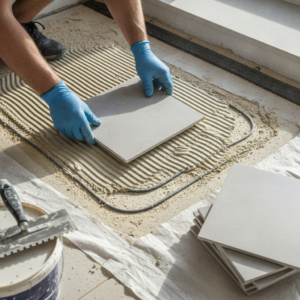
In simple terms, an uncoupling floor system is a membrane installed between the subfloor and the tile adhesive layer. Its job is to decouple the tiled surface from the underlying structure, hence the name.
By absorbing movement and reducing stress on the tiles, uncoupling systems allow for natural expansion, contraction, and even minor structural shifts — all without causing damage to the finished surface.
There are various types available, from plastic dimpled membranes to fabric-based mats, each with slightly different properties. Some also provide waterproofing, vapour management, or thermal insulation — making them a valuable multi-functional layer in complex installations.
Why Professional Tilers Insist on Uncoupling Systems
For professional tilers like the team at ProTiling WWC, the inclusion of uncoupling floor systems isn’t an upsell — it’s a standard part of high-quality workmanship.
That’s because we’ve worked on jobs where movement in the subfloor ruined thousands of pounds’ worth of porcelain tiles. In many cases, the homeowners had no idea that an uncoupling system was even an option. They assumed the adhesive alone would be enough. It’s not.
These systems provide peace of mind, not just for the client but also for the installer. They reduce the risk of call-backs, protect the reputation of the business, and ensure the installation performs for years to come.
For large format tiles in particular — which are more prone to stress-related cracking — uncoupling is absolutely critical.
When Are Uncoupling Floor Systems Needed?
While some subfloors may be more stable than others, the truth is that uncoupling floor systems are beneficial in almost every tiled floor installation.
They’re particularly important when:
- Installing over heated floors
- Working with newly laid concrete or screed (which is still curing)
- Laying tiles over timber or suspended floors
- Tiling on substrates with differential movement (like mixed materials)
- Renovating older properties where movement is inevitable
In other words, almost any modern or period property can benefit from this technology.
At ProTiling WWC, we evaluate every floor on a case-by-case basis, but our professional recommendation is always to include an uncoupling layer unless the subfloor is completely stable — and very few are.
The Long-Term Value of Getting It Right
Some clients understandably question whether uncoupling floor systems are worth the extra cost. But what they’re paying for is insurance — against cracking, failure, and premature replacement.
Think of it like this: You wouldn’t fit a new roof without underlay. You wouldn’t wire a house without an RCD. And you shouldn’t tile a floor without an uncoupling membrane.
Over time, the savings from not needing to repair or re-lay tiles far outweigh the initial outlay. Plus, a well-installed uncoupling floor system improves overall performance and adds real value to the property.
Whether it’s a high-end kitchen renovation, a new-build bathroom, or a large commercial space — uncoupling systems make all the difference.
Why Choose ProTiling WWC?
At ProTiling WWC, we’ve built our reputation on doing things properly. That means using the best products, following the best practices, and always putting quality first.
When we install uncoupling floor systems, we’re not just ticking a box. We’re ensuring your tiled surface has the resilience to cope with real-world conditions — movement, moisture, heat, and time.
Our team is trained in the latest installation methods and product technologies. We work with trusted brands and always tailor the system to the specific project, whether it’s a domestic job or a commercial fit-out.
In short, we install tiled floors that are built to last — and uncoupling is a big part of that story.
We don’t cut corners — we install every layer with purpose, and uncoupling floor systems are a key part of our commitment to doing things the right way, not just the fast way.
Supporting Smart Design Choices
Modern renovations often include features like open-plan layouts, bi-fold doors, or heated floors — all of which introduce more movement and stress into the floor structure. This makes uncoupling floor systems even more critical in ensuring the tiled finish doesn’t just look great on day one, but performs well for years to come.
Final Thoughts: What’s Beneath Matters Most
Tiling might look like a surface-level game, but the real performance comes from what’s going on underneath. And when it comes to ensuring longevity, nothing is more critical than using the right uncoupling floor system.
It’s an invisible detail — but one that protects your investment, improves the finish, and ensures lasting results.
If you’re planning a tiling project and want it done right, speak to the team at ProTiling WWC. We’ll assess your subfloor, recommend the right uncoupling solution, and deliver a flawless finish that stands the test of time.
Want more from us in your Google results?