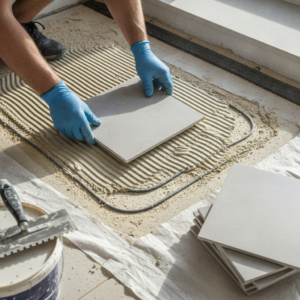
If you’ve recently had a tiled floor installed and you’re tapping across it wondering, why do floor tiles sound hollow, you’re definitely not alone. I’m the owner of ProTiling WWC, and this is one of the most common questions I get from homeowners across Wales, Devon, and the West Country.
You’ve invested in beautiful new flooring, the grout looks great, everything appears straight… then you walk across it or tap a tile and hear that unmistakable hollow sound. Naturally, alarm bells start ringing. Has something gone wrong? Will the tiles crack? Does the whole floor need replacing?
The good news is that a hollow sound doesn’t always mean disaster. But understanding why do floor tiles sound hollow can help you spot whether it’s completely normal, or a warning sign that needs professional attention.
What Causes a Hollow Sound Under Tiles?
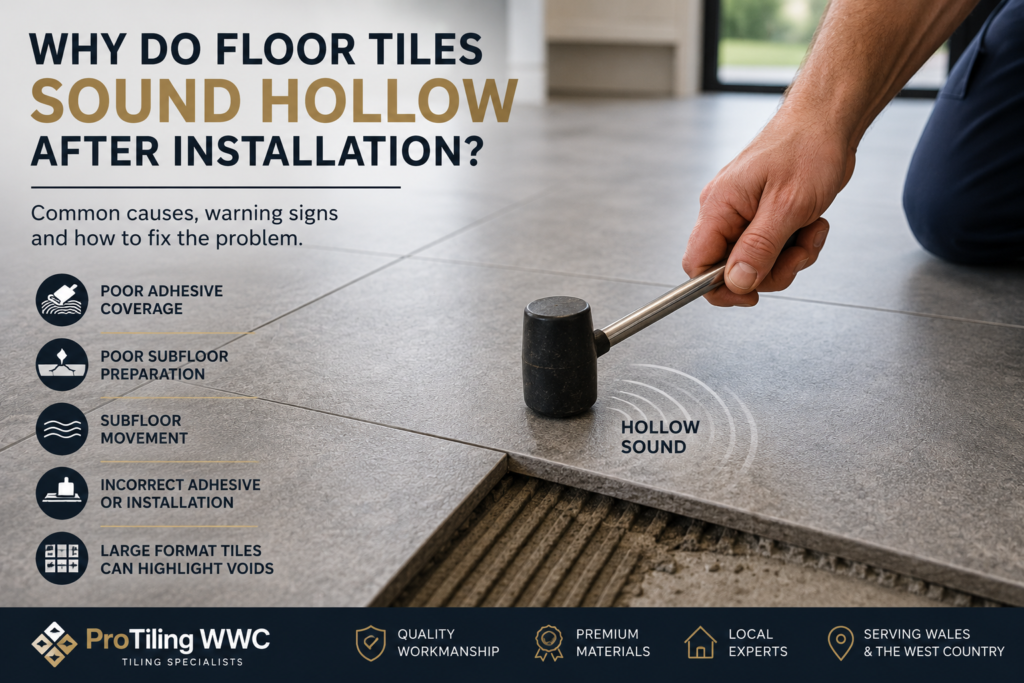
The most common reason homeowners ask why do floor tiles sound hollow is because there’s a gap somewhere between the tile and the substrate below.
Tiles should ideally have full adhesive coverage underneath, especially on floors. If there are voids, air pockets, or inconsistent adhesive application, parts of the tile may sound hollow when tapped.
This can happen for several reasons:
- Insufficient adhesive coverage
- Poor substrate preparation
- Uneven floors
- Incorrect adhesive choice
- Movement in the subfloor
- Rushed installation
That’s exactly why every ProTiling WWC project starts with proper substrate preparation before a single tile is laid.
Does a Hollow Tile Always Mean the Installation Has Failed?
Not necessarily. When people search why do floor tiles sound hollow, they often assume the worst, but that’s not always the case.
In some situations, a small isolated hollow spot may never cause an issue. The tile may remain perfectly secure for years.
However, if multiple tiles sound hollow, or you notice movement, cracking grout, or tiles lifting, it’s a sign something deeper may be happening underneath.
Poor Adhesive Coverage
One of the biggest reasons homeowners ask why do floor tiles sound hollow is poor adhesive coverage during installation.
On floor tiles, especially large-format porcelain, adhesive should cover almost the entire underside of the tile. British standards generally recommend very high coverage in wet areas and heavy-use spaces.
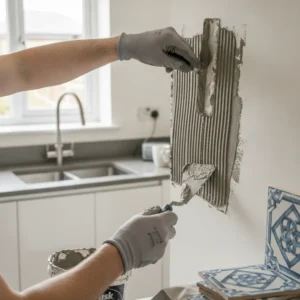
If adhesive has been dotted rather than fully trowelled, voids can form underneath, creating that hollow sound.
If you’re investing in porcelain, our guide on porcelain tiling contractors explains why installation quality matters so much.
Subfloor Movement
Another major reason people ask why do floor tiles sound hollow is movement beneath the tiles.
Timber floors, suspended floors, and older properties can naturally move over time. Without the right preparation, this movement can create tiny separations between the tile and adhesive.
That’s why we often install uncoupling floor systems to absorb movement and protect the tiled surface.
Could Underfloor Heating Be the Cause?
Sometimes homeowners searching why do floor tiles sound hollow have recently installed heated flooring.
Underfloor heating itself doesn’t cause hollow tiles, but poor installation around heating systems absolutely can.
If flexible adhesives aren’t used, or the floor hasn’t been correctly prepared, thermal expansion can create separation over time.
If your floor includes heating, our guide to underfloor heating tile compatibility is worth reading.
Large Format Tiles Can Highlight Voids
Modern homes increasingly use large-format tiles, particularly in open-plan spaces and projects like our recent floor tiling Cardiff installations.
Because these tiles cover more surface area, even small gaps underneath become more noticeable, leading homeowners to ask why do floor tiles sound hollow after installation.
How Can You Tell If It’s a Problem?
Ask yourself:
- Does the tile move when stepped on?
- Is grout cracking nearby?
- Are multiple tiles affected?
- Has the hollow area grown over time?
- Do you hear cracking sounds when walking?
If the answer is yes to any of these, it’s worth getting the floor checked professionally.
How We Prevent Hollow Tiles at ProTiling WWC
At ProTiling WWC, we prevent the issues that make people search why do floor tiles sound hollow by focusing on preparation, precision, and proven installation methods.
Every project includes:
- Full floor assessment
- Professional levelling
- Correct adhesive selection
- Back-buttering where required
- Movement protection systems
- Careful curing times
Whether it’s a bathroom, kitchen, or open-plan installation, the goal is always the same, long-lasting floors with no surprises.
Need Advice About Hollow Floor Tiles?
If you’re still wondering why do floor tiles sound hollow, I’m happy to take a look. Sometimes it’s nothing. Sometimes early intervention saves a costly repair later.
You can contact ProTiling WWC here, send over a few photos, or simply describe what you’re hearing.
Understanding why do floor tiles sound hollow is the first step, fixing the cause properly is what protects your floor for years to come.
– From your trusted tiling specialist at ProTiling WWC
Want more from us in your Google results?